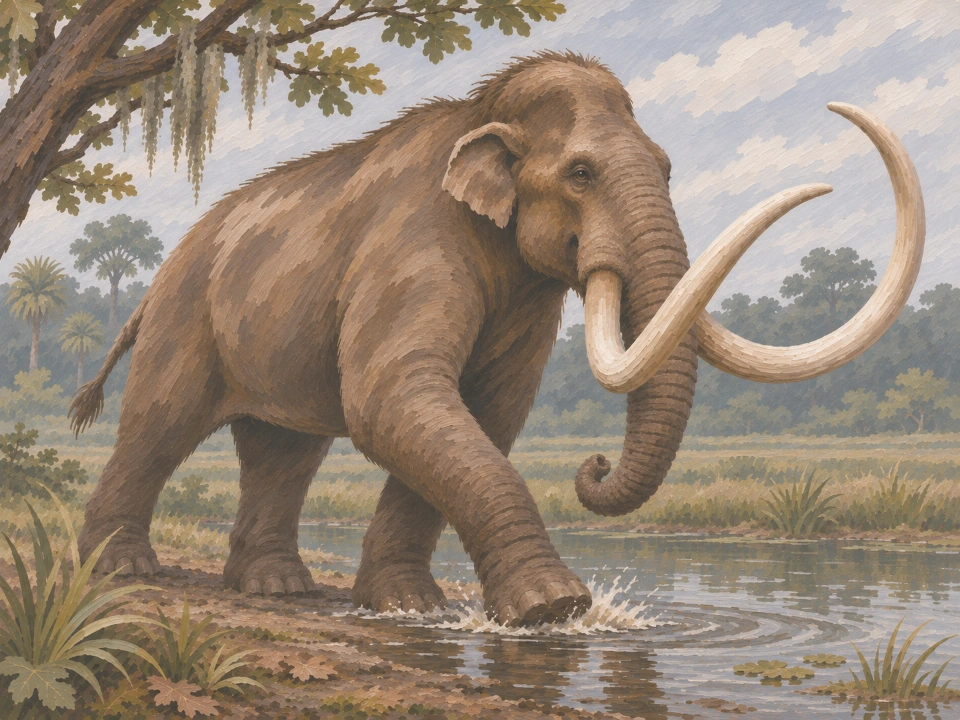
Woolly mammoth†
Mammuthus primigenius
The woolly mammoth (Mammuthus primigenius) was a large, cold-adapted elephantid that inhabited northern Eurasia and North America during the Pleistocene. It was characterized by its thick, woolly coat, relatively small ears, and long, strongly curved tusks. Woolly mammoths were widespread across the mammoth steppe, including the region now submerged beneath the North Sea, where their remains are among the most commonly encountered Pleistocene fossils.
Their molars are particularly distinctive, with very high crowns, numerous closely packed lamellae, and relatively thin enamel. Compared to earlier mammoths, such as the steppe mammoth (M. trogontherii), they generally have a higher lamellar frequency, meaning more plates within a given length of the crown. Their teeth frequently break apart along these plates, making isolated lamellae and tooth fragments common finds. Even small fragments can often be recognized as mammoth, although identifying the exact species is not always possible.